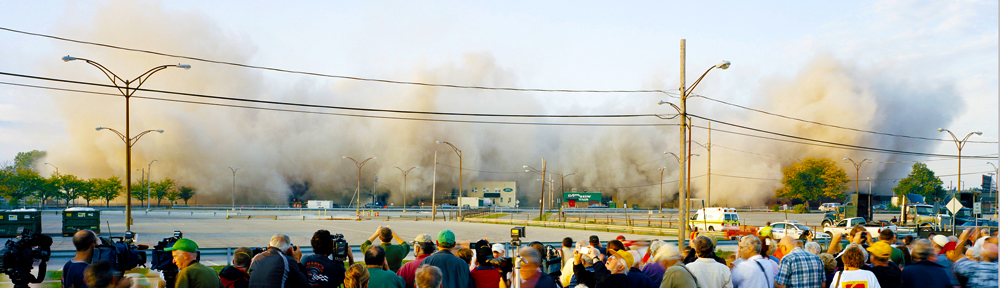
AFTER THE FAILED IMPLOSION OF THE KODAK-PATHÉ BUILDING GL, CHALON-SUR-SAÔNE, FRANCE DECEMBER 10, 2007

Chalon-sur-Saône, located south of Dijon in Burgundy, France, played an important role in the history of photography: it was here in 1827, that inventor Joseph Nicéphore Niépce created the first surviving photograph. Tourists can still visit the third-floor laboratory in the nearby village of Saint-Loup-de-Varennes, where Niépce successfully fixed the image of his camera obscura onto a pewter plate, using chemicals mixed with bitumen of Judea.
It was only fitting that Kodak would establish a manufacturing facility in Chalon, the city that claimed to have invented photography. They did so in 1961, by which time Niépce’s invention had grown into a global phenomenon. The plant seen on the facing page, operated by Kodak-Pathé, produced a variety of film products for nearly fifty years. When Kodak announced the facility would be closed in 2006, it was a shock not just to the city’s economy, but its citizens as well. On a gray December morning in 2007, crowds gathered to watch the death of photography in its birthplace. Photography refused to go quietly. After the demolition team had set off the 950 kilograms of explosives placed at the base of the building, only a portion of the structure came down. An embarrassed group of Kodak executives were forced to schedule a second attempt in February of 2008, which successfully ended the company’s presence in Niépce’s city.